Introduction
For businesses processing Crypto payments at scale, conversion costs quietly erode margins. Fees are rarely visible as a single line item. Instead, they accumulate across exchange spreads, FX conversions, network fees, and payment rail charges. When a business relies on a single on/off-ramp provider, these costs are fixed, opaque, and difficult to optimize.
Smart routing changes this dynamic. Rather than accepting a single provider’s pricing and rails, businesses can route each transaction through the most efficient available path in real time. This approach borrows from capital markets and card payment orchestration, where smart order routing and liquidity aggregation have long been standard practice.
In Crypto-fiat conversion, smart routing is quickly becoming the difference between paying market rates and paying unnecessary premiums.
Where Crypto-Fiat Conversion Costs Come From
Every Crypto-fiat conversion includes several cost layers, even when they are not clearly itemized.
The first is provider spread. Each on/off-ramp sets its own buy and sell rates, often adding 1-5 percent above market price. This spread is influenced by liquidity depth, risk appetite, and internal costs. When only one provider is available, the business has no benchmark or alternative.
The second layer is FX conversion. Many transactions involve multiple currencies before reaching Crypto. A GBP user buying USDC or BTC may be converted GBP to EUR, then EUR to USD, before reaching Crypto. Each hop introduces spread and slippage.
Third are blockchain network fees. High-security networks such as Bitcoin and Ethereum can experience congestion-driven fees ranging from a few dollars to tens of dollars per transaction. Meanwhile, alternative networks and layer-2 solutions often process the same value for fractions of a cent (layer-2 = infrastructure built on top of an existing blockchain that can execute transactions off-chain. While they process transactions separately, Layer-2 blockchains are still secured by the underlying Layer-1 blockchain.). Without routing logic, businesses default to the most popular, not the most efficient, network.
Finally, traditional payment rails introduce their own costs. Card payments typically add 1.5-3.5 percent in processing fees. International wires and correspondent banking chains introduce delays and intermediary charges.
When combined, these layers can push total conversion costs well above 4-5 percent for a single transaction.
How Smart Routing Actually Works
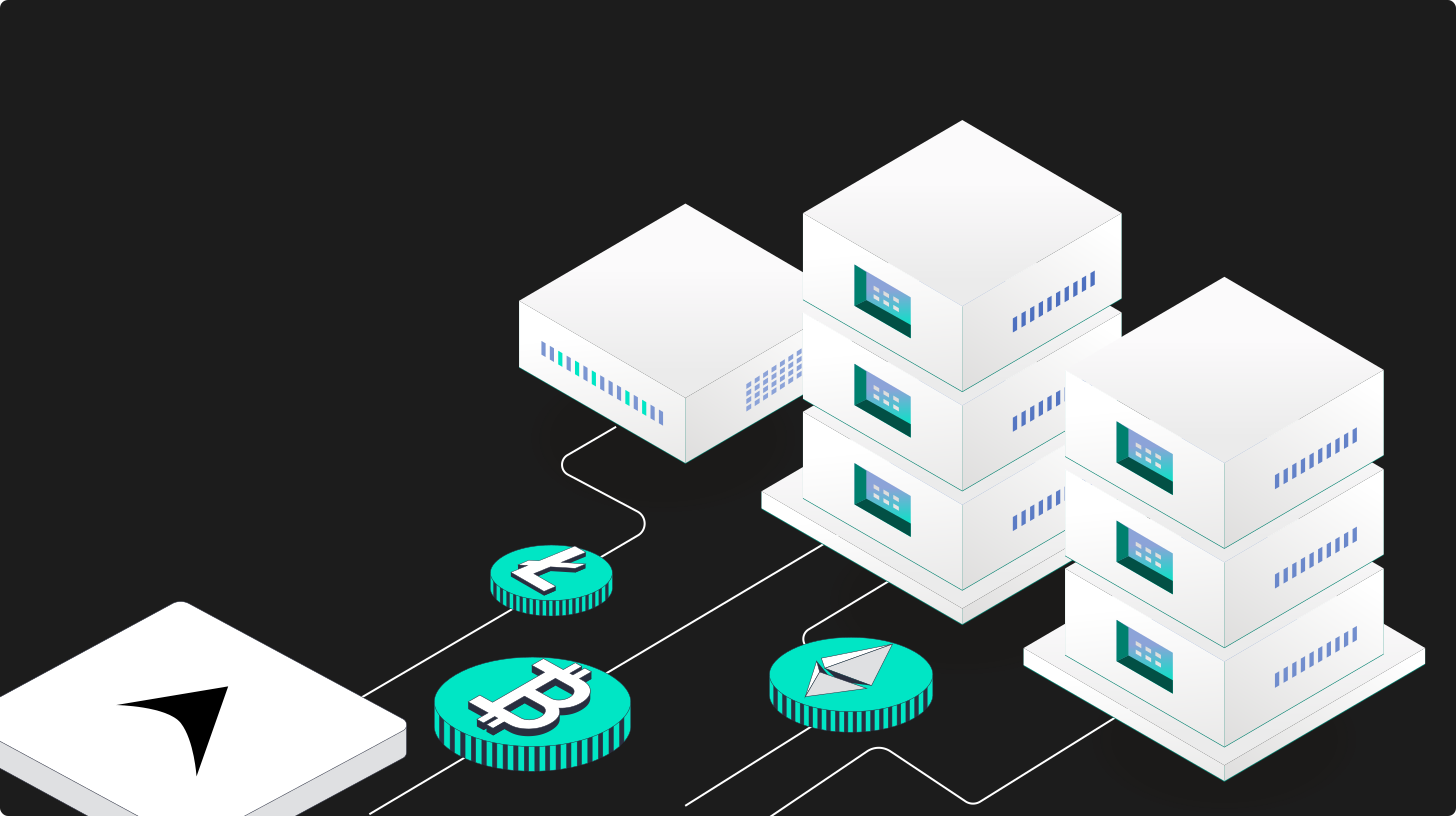
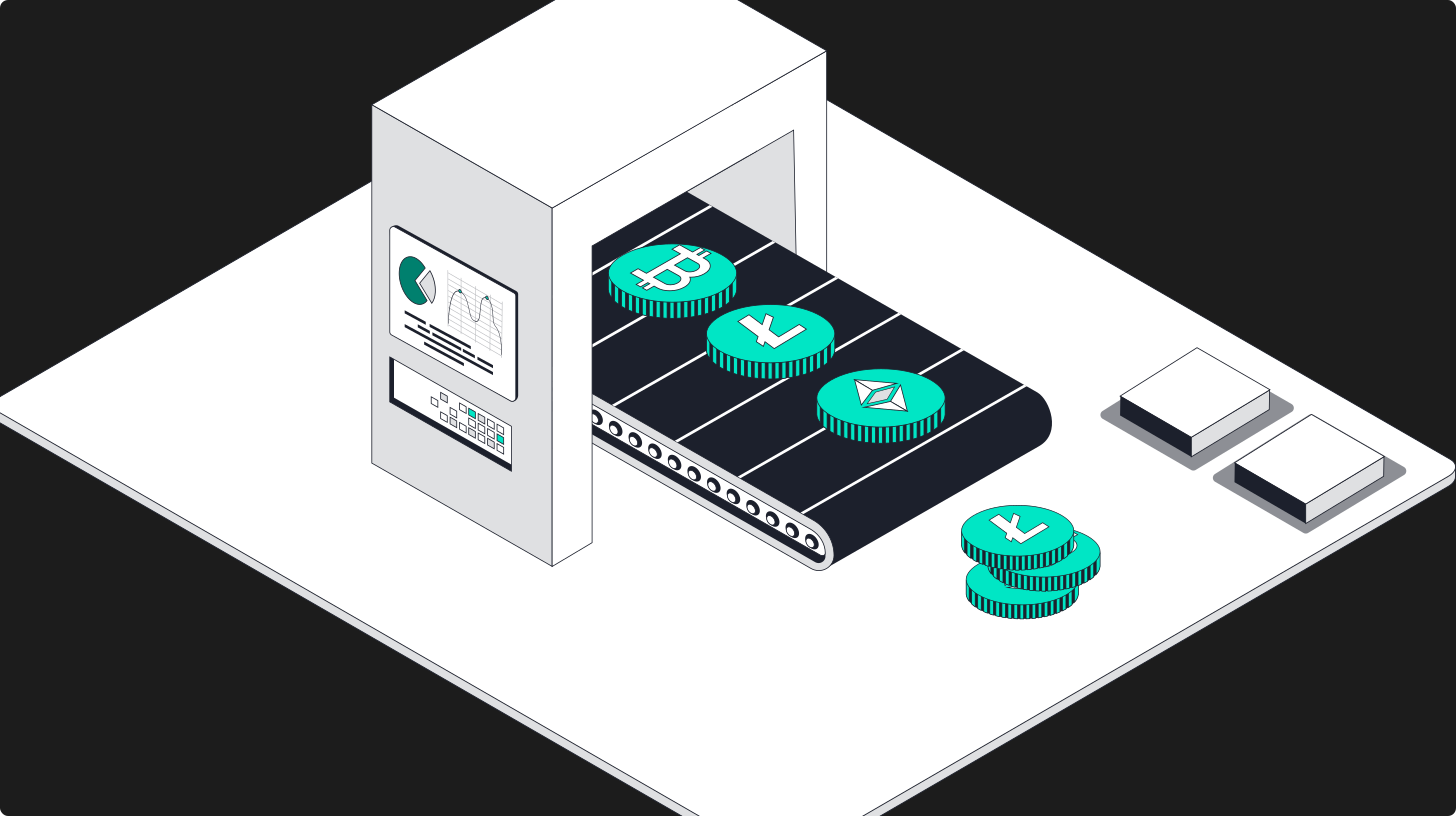
Smart routing platforms connect a business to multiple on/off-ramps, banking partners, liquidity sources, and rails through a single integration. At the moment a transaction is initiated, the routing engine evaluates every available path.
The logic typically compares:
Exchange rates and provider spreads
FX conversion paths
Network fees and blockchain congestion
Transaction limits and liquidity depth
Rail availability and settlement speed
The system then selects the route that maximizes net value for the business or end user.
For example, if a customer initiates a payment in GBP but the most competitive Crypto liquidity is priced in EUR, the router may convert GBP to EUR through an optimized FX rail before converting to Crypto. In other cases, a transaction may be split across multiple routes, with part settled via instant bank transfer and part via card or stablecoin rails.
This approach mirrors smart order routing in financial markets, where trades are fragmented across venues to achieve the best execution.
Liquidity Aggregation and Spread Compression
One of the most powerful effects of smart routing is spread compression. When multiple providers compete for flow, pricing improves naturally.
Aggregated liquidity allows routing engines to compare bids and asks across providers in real time. If one provider offers a better rate or lower fee at that moment, the transaction is routed there automatically. Over time, this competition narrows spreads and reduces slippage.
For large transactions, routing engines can also break orders into smaller chunks executed across multiple sources. This avoids the price impact that often occurs when a single provider absorbs a large order.
In practical terms, deeper liquidity leads to lower effective conversion costs, particularly for businesses processing high volumes or operating in volatile markets.
Economic Impact for Merchants
The financial impact of smart routing is measurable and recurring.
Consider a business converting €50,000 into Crypto. A single on/off-ramp charging a 3 percent spread results in €1,500 in fees. A routed approach might split the transaction across two or three providers with spreads between 1.5 and 2 percent, reducing total fees to under €1,000.
At scale, these savings compound. For a business processing €1 million per month in Crypto volume, even a 2 percent improvement in conversion efficiency represents €20,000 retained monthly. Over a year, this becomes a meaningful margin advantage.
Beyond direct savings, improved pricing allows businesses to offer better rates to customers, reduce friction, or reinvest in growth.
Reducing Blockchain Network Fees Through Routing
Network fees are one of the most volatile components of Crypto-fiat conversion. Smart routing mitigates this by dynamically selecting the most cost-effective settlement network.
If a payment involves stablecoins, the router may choose between multiple supported chains based on real-time gas costs. High-fee mainnets can be avoided in favor of lower-cost networks or layer-2 solutions without changing the asset itself.
This is particularly important for smaller transactions, where fixed network fees can otherwise exceed the value of the payment. Routing logic ensures that network costs remain proportional to transaction size.
Single-Provider vs Aggregated On/Off-Ramp Models
A single-provider setup locks a business into one pricing structure, one set of rails, and one operational risk profile. If fees increase, liquidity dries up, or a rail becomes unavailable, there is no immediate alternative.
An aggregated on/off-ramp model introduces flexibility. If one provider experiences downtime, routing logic automatically shifts traffic to another. If a rail becomes congested, the system selects a different path.
This redundancy improves approval rates and reduces failed transactions, which directly impacts revenue and user experience. From the business perspective, aggregation acts as both a cost optimizer and a risk mitigation layer.
Additional Considerations for Businesses
Smart routing platforms often incorporate additional logic beyond pricing.
Dynamic FX handling allows cross-currency flows to be optimized instead of forcing direct, expensive conversions.
Compliance-aware routing can direct smaller transactions through lighter verification paths while ensuring larger flows meet enhanced AML requirements.
Unified integrations simplify operations by consolidating multiple payment methods and rails under one API.
These features reduce internal complexity while improving performance.
Conclusion
Smart routing turns Crypto-fiat conversion into an adaptive, market-driven process. By aggregating liquidity, payment rails, and networks, businesses consistently reduce spreads, minimize network fees, and improve transaction success rates.
In an environment where margins are increasingly competitive and compliance requirements are rising, relying on a single on/off-ramp is no longer optimal. Aggregated routing infrastructure allows businesses to achieve better economics without increasing operational burden.
For companies processing meaningful Crypto volumes, smart routing is no longer an optimization. It is becoming standard infrastructure.
Routing funds, the smart way.
Payonite’s smart routing platform connects businesses to multiple Crypto-fiat on/off-ramps, banking partners, and rails in real time. To see how routing optimization can reduce your conversion costs and improve approval rates, contact our team and we’ll get back to you!
Key Takeaways
Aggregated on/off-ramps compress spreads by introducing real-time pricing competition.
Smart routing dynamically selects the lowest-cost FX, liquidity, and network paths.
Network fees are reduced by routing transactions through efficient chains and rails.
Approval rates increase through automatic failover and rail switching.
At scale, even small percentage improvements deliver significant margin gains.
Smart routing APIs allow businesses to optimize Crypto payments without operational complexity.
Reach out!