
Introduction
Crypto payments are frequently promoted as cheaper and faster than traditional payment rails. In principle, that is true. In practice, many businesses integrating Crypto on-ramps encounter a layered cost structure that is not immediately visible.
A typical on-ramp transaction may involve multiple currencies, liquidity providers, blockchain networks, compliance checks, and banking partners. Each step introduces friction and fees. Individually, these costs appear minor. At scale, they compound into a material drag on margins.
Understanding these hidden costs is essential for founders, finance leaders, and product teams integrating Crypto payments. More importantly, understanding how aggregator platforms and smart routing reduce these costs is now a competitive necessity.
Exchange Spreads and Liquidity Costs
The largest hidden cost in Crypto on-ramps is the exchange spread.
An on-ramp may advertise a low service fee while embedding a wide bid-ask spread into its quoted rate. Two providers offering the same asset at the same time can differ by 0.5 percent to 1.5 percent in effective price. Over meaningful volume, this difference becomes significant.
Liquidity fragmentation worsens the issue. Many on-ramps rely on a single exchange or liquidity provider. When order sizes increase, available depth decreases and spreads widen further. Large conversions can also move the market mid-trade, creating slippage.
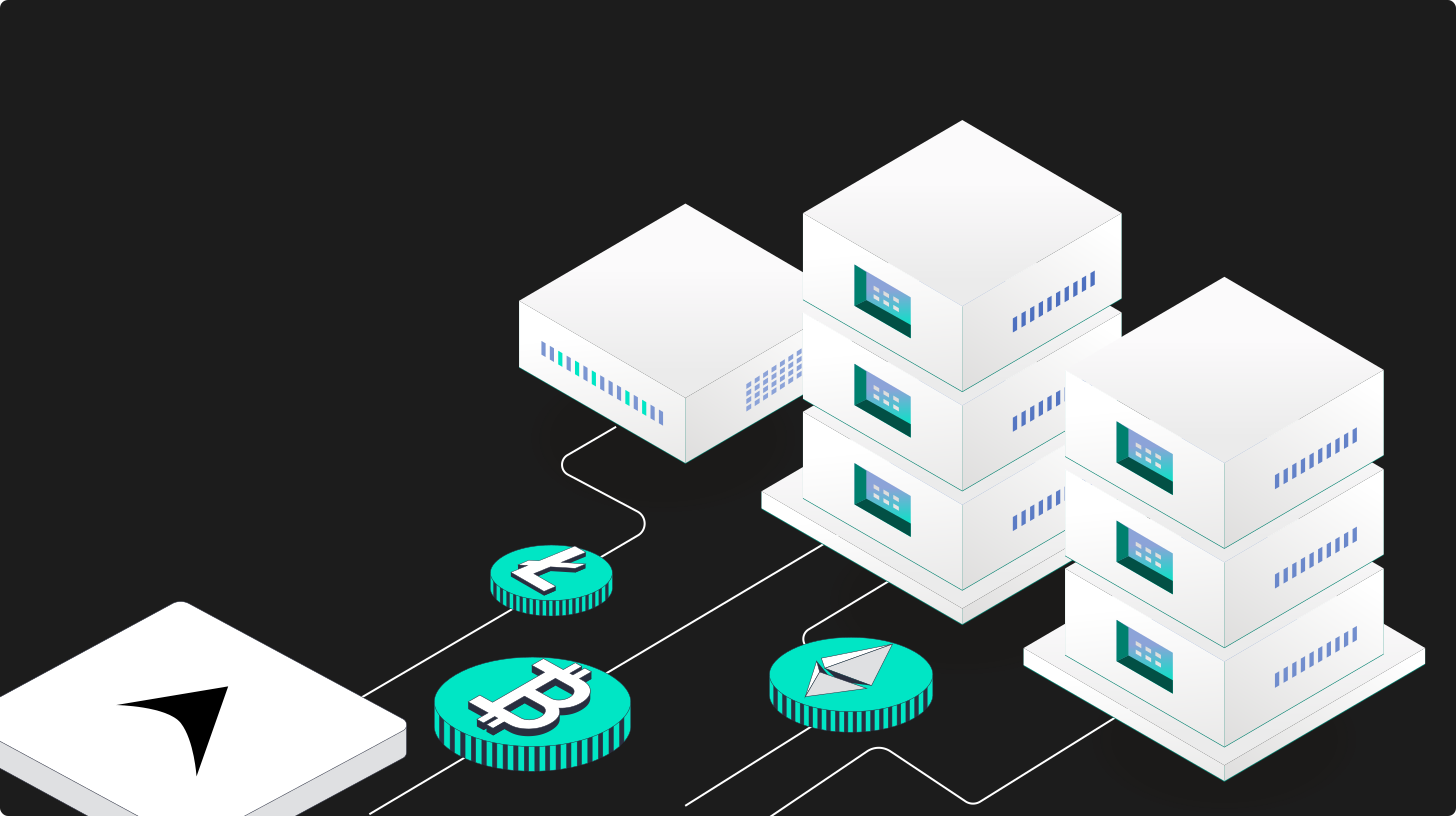
Aggregator platforms address this by pooling liquidity across multiple venues. Orders are split and routed dynamically, reducing market impact and improving average execution price. Instead of consuming liquidity from a single book, the transaction is executed across several sources at optimal size.
For businesses processing tens or hundreds of thousands per month, even small spread improvements translate into substantial savings.
FX Conversion and Cross-Currency Costs
Crypto on-ramps rarely operate in a single currency environment.
A European merchant may accept USD card payments, convert into Crypto, and later settle in EUR. Each currency hop introduces FX costs, often hidden within bank rates or provider markups.
Traditional banking rails frequently apply FX margins of 1 percent to 3 percent, particularly when SWIFT or card schemes are involved. In many cases, businesses pay FX costs multiple times without realizing it.
Smart routing reduces this by minimizing unnecessary currency hops. Aggregators can route transactions through stablecoins or local currency rails, selecting the cheapest conversion path dynamically.
For example, converting EUR to a EUR-backed stablecoin and settling locally may be cheaper than routing through USD intermediaries. These optimizations are invisible at the checkout level but critical at scale.
Blockchain Network and Gas Fees
Network fees are another commonly underestimated cost.
Public blockchains charge transaction fees that fluctuate based on congestion. On high-traffic networks, a single transaction can cost several dollars or more. For small or frequent transactions, this can erode margins quickly.
Aggregator-based on-ramps mitigate this by supporting multiple chains and routing transactions to the most cost-efficient network available. Lower-fee chains and layer-2 networks often offer comparable security for payment use cases at a fraction of the cost.
Advanced systems also monitor network conditions in real time, timing transactions by avoiding congested periods, or rerouting traffic automatically. This ensures predictable costs rather than volatile fee spikes.
Off-Ramp and Banking Overhead
On-ramp costs cannot be viewed in isolation. Every on-ramp eventually connects to an off-ramp.
When Crypto is converted back into fiat, additional fees arise from banking partners, settlement rails, and local payment systems. International wires, correspondent banking, and intermediary fees add both cost and delay.
Aggregators reduce these expenses by maintaining multiple off-ramp relationships across jurisdictions. Transactions are routed through local clearing systems wherever possible, avoiding expensive international transfers.
This not only lowers fees but improves settlement speed, which directly impacts working capital and liquidity management.
Compliance Delays as an Economic Cost
Compliance itself is not a fee, but it creates economic cost through delay.
Large transactions or high-risk flows often trigger enhanced due diligence. Funds may be held pending review, exposing businesses to market volatility and liquidity constraints.
Aggregator platforms mitigate this by routing transactions through partners best equipped to handle specific risk profiles efficiently. Some providers specialize in high-volume flows, others in high-risk compliance. Smart routing directs each transaction accordingly.
While compliance cannot be eliminated, its operational impact can be minimized through infrastructure design.
How Aggregation and Smart Routing Reduce Total Cost
The key insight is that Crypto conversion cost is not a single fee. It is a system-level outcome.
Aggregator platforms optimize across every layer simultaneously. Liquidity sourcing, FX paths, network selection, banking rails, and compliance handling are all evaluated in real time.
Instead of asking which provider has the lowest advertised fee, businesses should ask which infrastructure produces the lowest all-in cost across volume, geography, and transaction type.
In practice, aggregation often reduces total conversion cost by meaningful percentages compared to single-provider setups, especially as transaction volume grows.
Practical Cost-Reduction Strategies for Businesses
Businesses integrating Crypto on/off-ramps should prioritize infrastructure that supports aggregation and routing logic.
They should benchmark effective rates, not headline fees. Settlement currency, network choice, and liquidity depth matter as much as service pricing.
Stablecoin rails can reduce FX complexity. Local on-ramps and off-ramps reduce banking overhead. Volume-based negotiations further improve economics.
Most importantly, cost optimization should be continuous. Market conditions, liquidity, and network fees change daily. Static setups become inefficient quickly.
Conclusion
Crypto on-ramps are not inherently expensive, but poorly designed integrations often are.
Hidden costs accumulate through spreads, FX conversions, network fees, banking overhead, and compliance delays. Without visibility and routing intelligence, these costs can erase the economic advantage of Crypto payments.
Aggregator-based infrastructure solves this by treating Crypto payments as a routing problem, not a single-provider service. By dynamically selecting the best path for each transaction, businesses reduce total cost while improving reliability and scale.
In 2025, efficient Crypto payments are no longer about access. They are about optimization.
Start Optimizing Your On/Off-Ramp Journey Today
Payonite provides multi-provider Crypto on-ramp and off-ramp infrastructure with built-in smart routing. Our platform optimizes liquidity, FX paths, network selection, and settlement rails to reduce total conversion cost. Reach out to see how Payonite can improve your Crypto payment economics.
Key Takeaways
Crypto on-ramp costs extend far beyond visible fees.
Exchange spreads and liquidity fragmentation are major hidden expenses.
FX conversions often introduce multiple layers of cost.
Blockchain network fees vary widely by chain and congestion.
Compliance delays create indirect financial impact.
Aggregator platforms reduce cost through smart routing across providers.
Optimized infrastructure turns Crypto payments into a scalable advantage.

Reach out!