
Introduction
Many legitimate industries are classified as “high-risk” by banks and card networks. Online gaming, trading platforms, adult entertainment, CBD products, remittance services, and certain digital goods marketplaces often face frozen accounts, high reserve requirements, or outright rejection from PSPs.
These restrictions are rarely about legality alone. They stem from chargeback exposure, cross-border complexity, fraud risk, and regulatory scrutiny. As a result, high-risk businesses struggle to access reliable, scalable payment infrastructure.
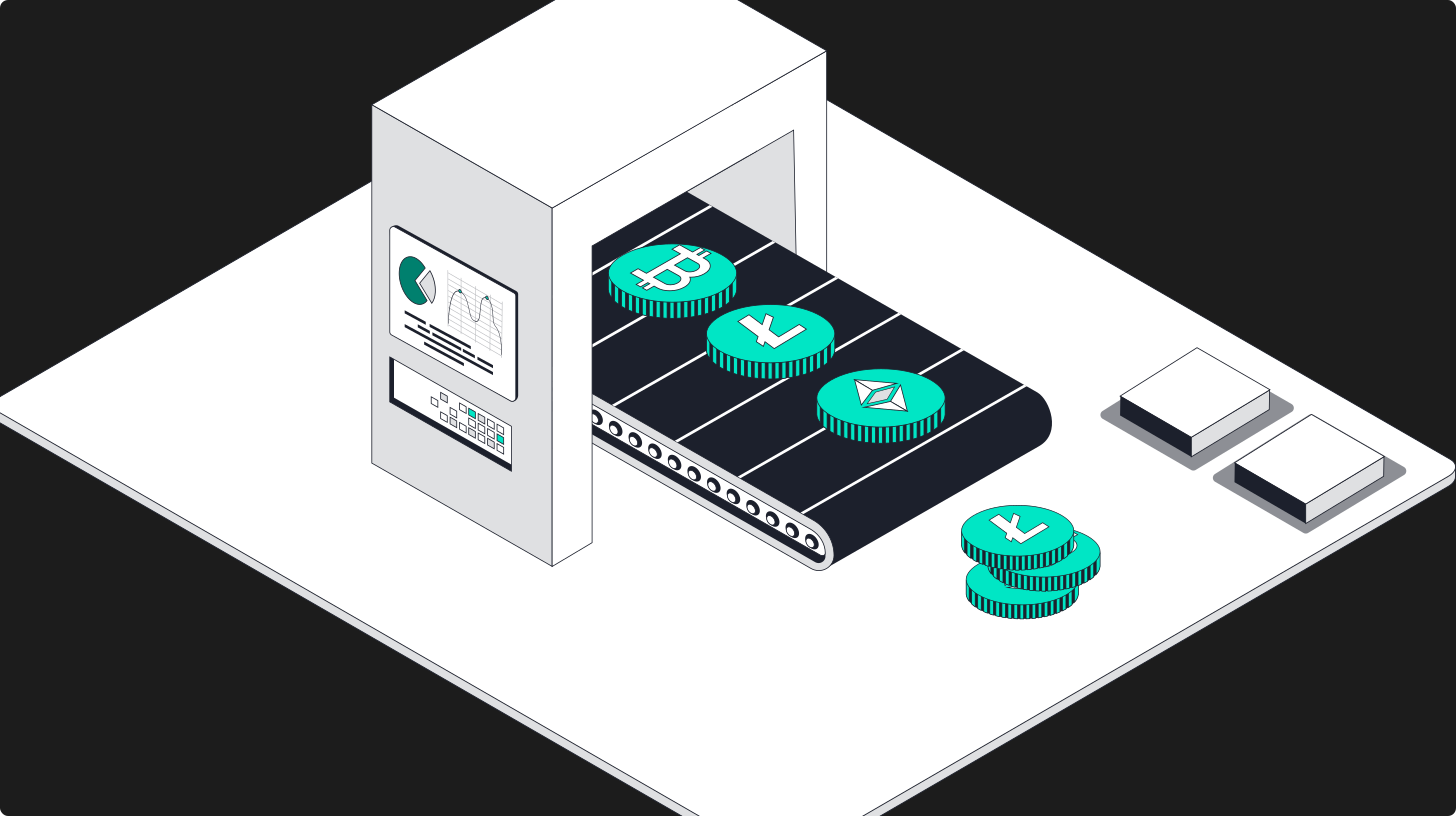
Crypto payments offer a different path. In 2025, high-risk sectors increasingly rely on Crypto rails, on-ramps, off-ramps, and aggregator platforms to move value globally while remaining compliant. This infrastructure allows payments to flow without the fragility of card networks or correspondent banking.
How Financial Institutions Classify Risk
Banks and PSPs categorize merchants based on industry, transaction behavior, geography, and regulatory exposure.
Gaming and betting platforms typically require specialized licenses and enhanced monitoring. Adult content and CBD businesses face reputational and regulatory sensitivity. Trading platforms and digital asset marketplaces raise concerns around market abuse and money laundering. Remittance and P2P services are scrutinized due to cross-border flows and sanction risks.
For these sectors, risk classification leads to higher fees, rolling reserves, transaction caps, or full de-risking. Even compliant, licensed businesses are often rejected because PSPs are unwilling to manage the operational burden.
Crypto payment providers approach this differently. Licensed Crypto PSPs are built to handle enhanced due diligence, transaction monitoring, and jurisdictional complexity. When high-risk merchants integrate Crypto rails, they inherit infrastructure designed specifically for regulated, high-volume, high-risk flows.
Why Crypto Rails Work for High-Risk Businesses
Crypto payments differ fundamentally from card-based systems.
Transactions are irreversible, eliminating chargeback exposure. Settlement is near-instant, reducing liquidity strain. Cross-border transfers bypass correspondent banking bottlenecks. Stablecoins offer predictable value without local banking dependencies.
Most importantly, Crypto rails allow compliance to be embedded at the infrastructure layer rather than the merchant layer. This is where on-ramp and off-ramp aggregators become critical.
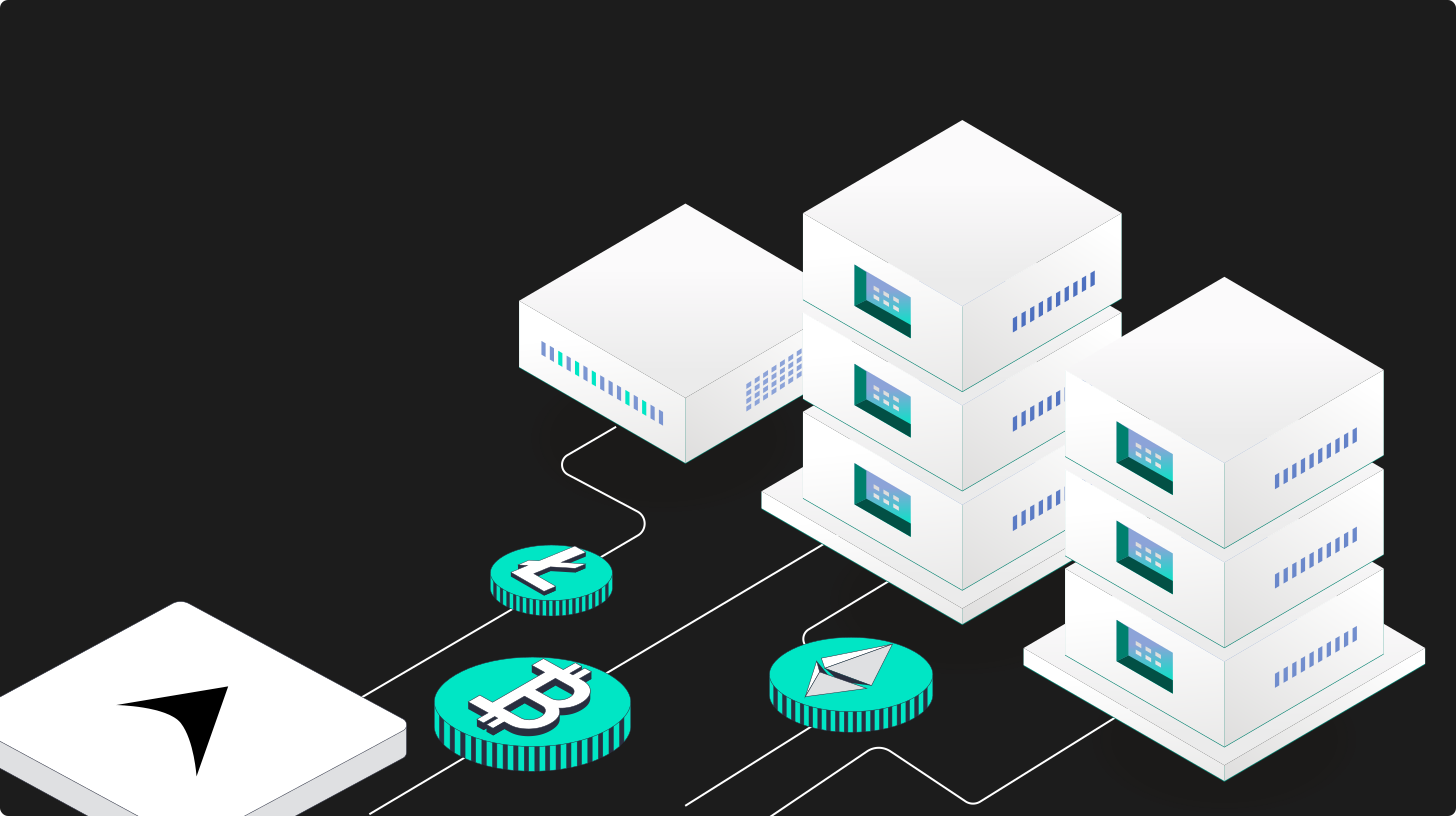
Instead of relying on a single bank or PSP, high-risk merchants connect to an aggregator that routes transactions through multiple regulated providers based on geography, asset, and risk profile. This creates redundancy, scalability, and regulatory alignment, avoiding a single point of failure.
Common Crypto Payment Models in High-Risk Sectors
High-risk industries rarely hold Crypto directly. Instead, they use custodial, outsourced payment flows.
A gaming platform, for example, may allow users to pay in Crypto at checkout. The Crypto is received by a licensed on-ramp provider, converted instantly into fiat or stablecoin, and credited to the user’s balance. The operator never controls the wallet or touches on-chain funds.
Trading platforms often separate asset trading from fiat movement. Crypto rails are used to fund accounts via stablecoins or settle withdrawals through off-ramps. The platform focuses on matching and execution, while regulated partners handle conversion and compliance.
Remittance services frequently use Crypto as the transport layer. Funds are tokenized into stablecoins, moved globally, then off-ramped into local currency for recipients. This reduces cost and settlement time while maintaining regulatory oversight through licensed providers.
Across these models, Crypto is the rail, not the product.
KYB, KYC, and Compliance Separation
High-risk businesses are still subject to AML and counter-terrorism financing rules. The key difference is how those obligations are fulfilled.
In a Crypto PSP model, the payment provider performs KYC on end-users, monitors transactions, and enforces sanctions screening. The merchant completes KYB once during onboarding and operates as a client of the regulated provider, or once for all potential providers through an aggregator.
This separation of responsibilities is crucial. The merchant does not act as a VASP or money transmitter. The licensed on-ramp or off-ramp assumes that role.
For regulators and banking partners, this structure is increasingly accepted, provided the Crypto PSP is properly licensed and audited. In the EU, MiCA-authorized providers fulfill this role. In the US and other regions, equivalent licensing frameworks apply.
Compliance becomes part of the payment flow, not a custom-built merchant obligation.
Aggregator Platforms and Smart Routing
Aggregator platforms are especially important for high-risk businesses operating across multiple regions.
Instead of relying on a single provider that may de-risk the merchant at any time, aggregators connect to multiple EMIs, exchanges, and Crypto PSPs. Transactions are routed dynamically based on amount, jurisdiction, asset type, and risk scoring.
If one route becomes unavailable, payments continue through alternative rails. This resilience is critical for industries historically affected by sudden account closures.
Aggregators also allow businesses to scale globally without renegotiating banking relationships country by country.
Real-World Adoption Patterns
Gaming operators use Crypto rails to enable instant deposits without chargebacks.
Trading platforms fund accounts via stablecoins while off-ramping profits locally.
Remittance apps move value globally using Crypto as the settlement layer.
Digital goods marketplaces accept Crypto without card network restrictions.
In all cases, the business benefits from speed, reliability, and compliance without assuming banking or custody risk.
Conclusion
High-risk industries are not avoiding regulation. They are avoiding infrastructure that was never designed for their business models.
Crypto rails, combined with regulated on-ramp and off-ramp aggregators, provide a compliant alternative to traditional PSPs. They remove chargeback risk, reduce settlement friction, and embed KYC and AML into the payment flow itself.
For high-risk founders and compliance leaders, the conclusion is clear. Crypto payment infrastructure is no longer experimental. It is a mature, regulated solution for industries that need resilient, global payment access.
Ensure Smooth Crypto Payments Through Payonite
Payonite provides compliant on-ramp and off-ramp infrastructure designed to support high-risk industries. Our aggregator model enables Crypto payments, smart routing, and fiat settlement while meeting regulatory expectations. Reach out to explore how Payonite can unlock new payment rails for your business.
Key Takeaways
High-risk industries are often excluded by traditional banks and PSPs.
Crypto rails provide irreversible, global payment infrastructure.
Licensed Crypto PSPs perform KYC and AML on end-users.
Merchants complete standard KYB and avoid custody risk.
Aggregator platforms enable redundancy and smart routing.
Crypto payments reduce chargebacks and speed up settlement.
Modern Crypto infrastructure allows high-risk businesses to operate compliantly at scale.
Reach out!